PicoClaw vs OpenClaw
Two self-hosted AI agents, built for opposite priorities: PicoClaw for ultra-light, low-cost hardware; OpenClaw for broad capability and browser automation. Here's how they compare.

PicoClaw vs OpenClaw at a glance
Choose PicoClaw
Run OpenClaw or PicoClaw against GPT, Claude, or an OpenRouter model. You own the automation and the data flow; the model stays external. The cheapest way into self-hosted AI.
Choose OpenClaw
For browser automation, broad messaging integrations, and multi-agent or multi-session workflows.
Lightest runtime
PicoClaw: core footprint advertised below 10 MB (project figure, core only; OS, model and browser are separate).
Most capable
OpenClaw: documented browser control, a wider channel ecosystem, and companion-device workflows.
Maturity
OpenClaw is released (still needs hardening); PicoClaw is pre-v1.0 and not recommended for production yet.
Not a fork
PicoClaw is a ground-up Go rewrite, not built on OpenClaw's TypeScript codebase.
PicoClaw vs OpenClaw: full comparison
>How the two agents line up across identity, architecture, hardware, integrations, and maturity — based on the official repositories and documentation, with roadmap items flagged as such.
| Category | PicoClaw | OpenClaw |
|---|---|---|
| Project identity | Independent Go implementation, built from scratch — not an OpenClaw fork. | Multi-channel personal AI assistant and self-hosted gateway platform. |
| Architecture | Go; compact, portable binary for constrained devices. | TypeScript core on Node.js, with gateway and companion-device components. |
| Deployment target | Edge/IoT, Raspberry Pi, RISC-V, ARM, MIPS, x86, Docker, lightweight VPS. | Cloud, desktop (macOS, Linux, Windows/WSL2), Docker, remote servers, companion devices. |
| RAM Official | Core footprint advertised below 10 MB; newer builds may use ~10–20 MB. | No single official RAM minimum published. |
| Messaging channels | 19+ listed: Telegram, Discord, WhatsApp, WeChat, QQ, Slack, Matrix, LINE, IRC, MQTT, and more. | Broad ecosystem: WhatsApp, Telegram, Slack, Discord, Signal, iMessage, Teams, Matrix, and more. |
| Browser automation | On the roadmap (CDP/ActionBook) — not yet an equivalent to OpenClaw’s documented system. | Officially documented: dedicated Chrome/Chromium profile, tabs, actions, screenshots, PDFs, CDP. |
| Multi-agent workflows | Agent/sub-agent features documented; smaller orchestration ecosystem. | Stronger documented sessions, routing, multi-agent workflows, and device nodes. |
| Maturity | Pre-v1.0, rapid development; repo advises against production before v1.0. | Released version line; production still needs hardening and workload testing. |
| Best fit | Constrained edge hardware, low-cost boards, lightweight portable automation. | Complex workflows, broad messaging, browser control, multi-agent coordination. |
What PicoClaw is best at
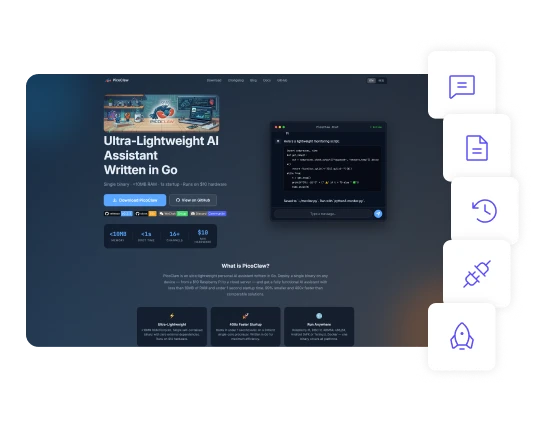
PicoClaw's advantage is efficiency and portability — a small single binary that runs where a large integration stack can't. It's a strong fit for:
- Messaging-based AI assistants and information retrieval.
- File read/write, shell commands, and lightweight code execution.
- Scheduled jobs and simple recurring automation.
- MCP-based extensions, with hosted or local model providers.
- Deployment on Raspberry Pi, RISC-V, ARM, x86, Docker, and other constrained systems.
What OpenClaw is best at
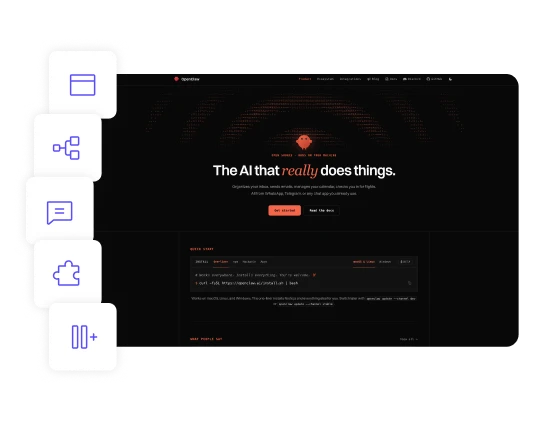
OpenClaw maximises what the agent can actually do, especially when it needs to touch websites, many communication systems, and external tools:
- Browser automation with a dedicated, controlled browser profile.
- Complex multi-step workflows, concurrent sessions, and agent routing.
- Broad messaging and collaboration integrations.
- Skills, extensions, plugins, and custom tools.
- Companion-device, voice, screen, camera, and Canvas-related workflows.
PicoClaw vs OpenClaw: hardware and VPS requirements
This is where the two diverge most. PicoClaw is designed to run on almost anything, including a low-cost single-board computer or the smallest VPS. OpenClaw has no official RAM minimum, but its broader gateway, browser, and multi-agent features mean you should provision conservatively and benchmark your actual workload.
| Consideration | PicoClaw | OpenClaw |
|---|---|---|
| Own runtime Official | Below 10 MB core (~10–20 MB newer builds) | No official minimum published |
| Practical VPS start | Smallest / cheapest VPS, or a low-cost SBC | ~2–4 GB small setups; 8 GB+ if browser-heavy |
| Runs on | Raspberry Pi, RISC-V, ARM, MIPS, x86, Docker, lightweight VPS | Desktop, server, cloud, Docker, remote Linux, companion devices |
| Get started | Cheap VPS for PicoClaw → | VPS with headroom for OpenClaw → |
Read these figures carefully: PicoClaw’s sub-10 MB number is a project-published figure for its core only — the OS, model inference, channels, and any browser processes are separate. OpenClaw has no official RAM requirement; the 2–4 GB and 8 GB+ figures are provisional third-party estimates for provisioning, not official minimums. Benchmark your own release and workload before committing.
Frequently asked questions
Is PicoClaw a fork of OpenClaw?
No. PicoClaw is an independent implementation written in Go from scratch, not a fork of OpenClaw’s TypeScript codebase. It targets a compact, portable runtime for constrained devices, while OpenClaw is a broader gateway-based assistant platform.
Which uses less RAM, PicoClaw or OpenClaw?
PicoClaw is far lighter — its makers advertise a core footprint below 10 MB (around 10–20 MB on newer builds). OpenClaw publishes no official RAM minimum. Note that both figures exclude the operating system, model inference, and any browser processes.
Can PicoClaw do browser automation like OpenClaw?
Not yet at the same level. PicoClaw lists headless browser automation on its roadmap, whereas OpenClaw has a documented browser-control system with a dedicated Chrome or Chromium profile, tabs, actions, screenshots, and PDFs. If browser automation is core to your use case, OpenClaw is the safer choice today.
Should I run PicoClaw or OpenClaw on a VPS?
Both can run on a VPS. PicoClaw fits the smallest, cheapest VPS or a low-cost board. OpenClaw has no official minimum but benefits from more headroom — provision conservatively and benchmark, especially for browser-heavy or multi-agent workloads.
Is PicoClaw or OpenClaw production-ready?
OpenClaw is a released project but still needs security hardening, isolation, and workload testing before production. PicoClaw is pre-v1.0, and its own repository advises against production deployment until v1.0. For production today, OpenClaw after a security review is the more realistic option.
Which has more messaging integrations?
Both cover many channels. PicoClaw lists 19+ including Telegram, Discord, WhatsApp, WeChat, Slack, and Matrix. OpenClaw’s ecosystem is broader still, adding channels like Signal, iMessage, and Microsoft Teams. A listed channel doesn’t guarantee identical depth or reliability, so verify the specific integration you need.
Capabilities, RAM figures, and roadmap status in this comparison are drawn from the official OpenClaw and PicoClaw repositories and may change between releases. Verify the current documentation and any security advisories before deploying either agent.