
OpenClaw helped popularize the idea of a personal AI agent that can use tools, automate workflows, connect to chat apps, read files, browse, and run shell commands on your machine. That flexibility made it powerful, but it also introduced major concerns around size, security, and control.
Several projects have emerged as alternatives to OpenClaw, each keeping the core idea of an agent that can use tools while changing the security model, footprint, or deployment environment. The main alternatives are NanoClaw, IronClaw, PicoClaw, and Moltworker.
What is OpenClaw?
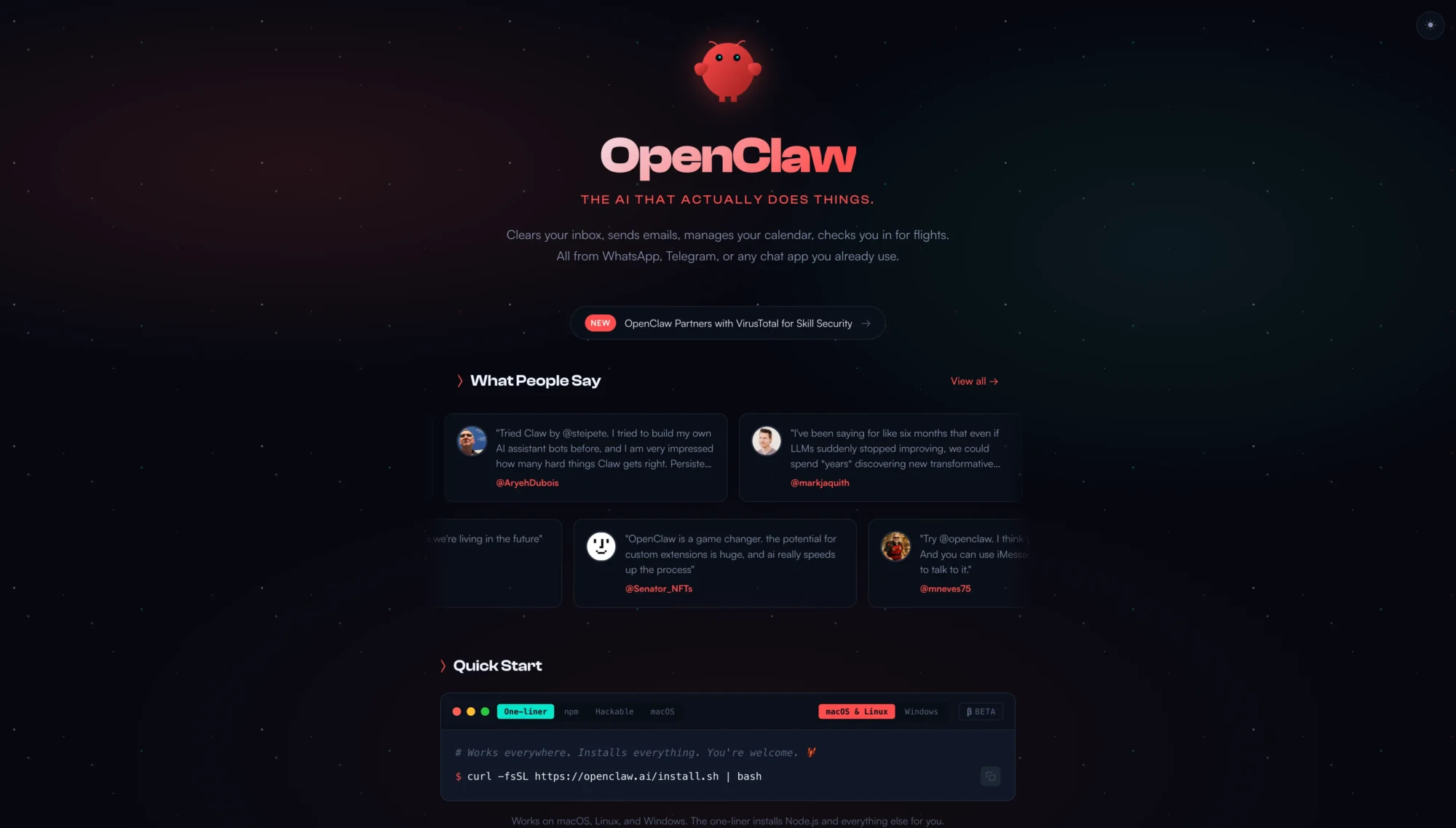
OpenClaw is a popular open-source personal AI agent framework, formerly known as Clawdbot/Moltbot. It runs on your machine and can connect to apps such as WhatsApp, Telegram, and Slack. It can also read files, browse, run shell commands, and automate workflows autonomously.
The trade-off is that OpenClaw is very large and monolithic. Its codebase is around 430k lines, with more than 70 dependencies and over 50 config or support files. Its permission model relies on application-level checks, which makes it capable but difficult to fully audit.
Recent security analysis and a real-world incident, where an OpenClaw agent bulk-deleted a Meta AI safety director’s inbox despite instructions not to act without approval, highlighted the risks of combining broad host access with a large codebase.
Why people are looking for alternatives to OpenClaw
All of the main OpenClaw alternatives respond to the same core issues: size, safety, and trust. They do not reject the concept of an AI agent with tools. Instead, they redesign the environment in which the agent runs or the way permissions are granted.
Some focus on making the system much smaller and easier to audit. Others isolate the agent in containers or cloud environments. Others remove default permissions entirely and require explicit access grants. Together, these projects show a clear trend toward safer and more controlled AI agent frameworks.
NanoClaw: minimal and container-first
NanoClaw is a from-scratch reimplementation of the OpenClaw idea. Its goal is to shrink the framework into a tiny, auditable codebase while running agents inside real operating system containers instead of relying on in-process permission checks.

How small is NanoClaw?
The phrase “OpenClaw in around 500 lines of code” refers to the core orchestrator loop, not the full repository. Even so, the full project remains much smaller than OpenClaw. It has about 15 source files and roughly 3.9k lines of code compared with OpenClaw’s roughly 434k. It also uses fewer than 10 dependencies and has zero config files.
How NanoClaw improves safety
Each NanoClaw agent runs inside an isolated Apple Container on macOS or a Docker container on Linux. It only sees directories that the user explicitly mounts into that container. There is no shared host filesystem by default.
This means the security model comes from operating system-level container isolation and a much smaller attack surface, rather than a large set of application-level permission checks inside one Node process.
Why NanoClaw stands out
NanoClaw’s philosophy is that the system should be small enough to fit inside a single LLM context window. In practice, that means the model can help walk through every line of the system and even assist with safer modifications. For users who value simplicity, auditability, and a cleaner design, NanoClaw is one of the clearest alternatives to OpenClaw.
IronClaw: zero-trust and capability-based security
IronClaw takes a different route. It is not just a simpler OpenClaw clone. It is a separate framework built around zero-trust principles, where security is central to the architecture.

How IronClaw works
Every tool or skill in IronClaw runs inside its own WebAssembly sandbox. By default, that sandbox has no access to the host filesystem, network, shell, or other system resources.
Explicit permissions only
Access is granted only through capability tokens. For example, a tool might receive FileRead permission for a specific path, or NetConnect permission for a short allow-listed set of hosts and ports. Nothing is allowed automatically.
Audit trail and blast-radius reduction
IronClaw includes an append-only audit trail that logs every capability grant, tool invocation, and denied operation. Because nothing has default permissions, even a compromised or malicious skill is limited to the narrow capabilities it was explicitly given.
Compared with OpenClaw’s broad host access model, IronClaw dramatically reduces the blast radius of failure. That makes it a strong option for users who care most about strict control, explicit sign-off, and auditability.
PicoClaw: ultra-lightweight agents for cheap hardware
PicoClaw is an open-source AI agent framework from Sipeed, written in Go and designed for ultra-cheap hardware such as the LicheeRV-Nano and similar Linux-capable boards in the $10 range.

Why PicoClaw is different
PicoClaw focuses on efficiency. It targets a sub-10MB RAM footprint and around a 1-second boot time. That makes it far lighter than typical OpenClaw setups, which can require more than 1GB of RAM and a much more expensive machine.
Launch and early momentum
The project launched on February 9, 2026 and gained fast attention. It reached around 8.4k GitHub stars within 6 days and roughly 12k stars within its first week, an unusually fast growth rate for a niche AI agent framework.
Technical focus
PicoClaw is built around architectural efficiency rather than model compression. It uses the Model Context Protocol (MCP) for tool integration, supports sub-agents and heartbeats, and can connect to any OpenAI-compatible API, often through routers like Crazyrouter to access many models at lower cost.
For anyone looking for an OpenClaw alternative that can run on extremely limited hardware, PicoClaw stands out for its low footprint and fast startup.
Moltworker: OpenClaw moved into Cloudflare’s sandbox
Moltworker takes yet another approach. Instead of rewriting the whole framework from scratch, it packages OpenClaw to run inside Cloudflare Workers and the Cloudflare Sandbox or Containers environment.
What Moltworker changes
With Moltworker, the agent runs in Cloudflare’s serverless environment instead of on your personal machine. State is stored in services like R2, while authentication and API key management are handled by Cloudflare’s AI Gateway.
Why this matters for safety
Because execution happens inside Cloudflare’s platform, the agent cannot directly access your local files, email client, or operating system. There is no direct local disk or shell access. Any external access must go through Cloudflare-controlled storage and network primitives.
Moltworker as a practical OpenClaw alternative
The repository is labeled as a proof of concept, but community write-ups note that it is already used internally in scenarios such as Slack deployments. On a paid Workers plan, a continuously running agent costs only a few dollars per month.
Moltworker is especially relevant for users who like the OpenClaw concept but do not want the agent running directly on their own machine.
Which alternative to OpenClaw is best?
Claw Runtime Projects — At a Glance
Compare all five projects across security model, hardware requirements, and ideal use case
| Project | Main goal | Security model | Hardware / env | Best fit use case |
|---|---|---|---|---|
| OpenClawFull-featured | Full-featured personal AI agent | App-level checks in a large monolith | Local Mac / server with >1 GB RAM | Maximum capability, many channels & skills |
| NanoClawSecure runtime | Small, auditable, secure runtime | OS containers per agent (Apple / Docker) | Same class of machines as OpenClaw | Security-conscious users who still want local host |
| IronClawEnterprise | Zero-trust, enterprise-grade safety | Capability-based WASM sandbox per tool | Server / infra with WASM runtime | Teams that prioritize provable sandboxing & logs |
| PicoClawEdge / IoT | Ultra-lightweight edge deployment | Minimal runtime, constrained environment | $10 boards, <10 MB RAM, 1-core CPUs | Edge / IoT agents, offline-first assistants |
| MoltworkerServerless | Safer OpenClaw via serverless cloud | Cloudflare Workers sandbox + R2 / Gateway | Cloudflare’s global worker platform | OpenClaw-style UX without local risk |
Final thoughts
OpenClaw helped define what a personal AI agent framework could do, but its large codebase, application-level permission model, and real-world safety concerns created demand for better approaches.
NanoClaw, IronClaw, PicoClaw, and Moltworker all keep the core idea of a tool-using AI agent, but each changes a key part of the system. NanoClaw focuses on simplicity and containers. IronClaw focuses on zero-trust capability security. PicoClaw focuses on extreme efficiency. Moltworker focuses on cloud isolation.
Together, they represent the main directions for anyone exploring safer and more practical alternatives to OpenClaw.
FAQ
What are the main alternatives to OpenClaw?
The main alternatives covered here are NanoClaw, IronClaw, PicoClaw, and Moltworker.
Why are people searching for alternatives to OpenClaw?
They are mainly responding to OpenClaw’s large monolithic codebase, broad host access, and safety concerns linked to application-level permission checks.
Is NanoClaw really only 500 lines of code?
The 500-line claim refers to the core orchestrator loop, not the full repository. The full project is still much smaller than OpenClaw, at roughly 3.9k lines.
How is IronClaw different from OpenClaw?
IronClaw uses a zero-trust, capability-based model where every tool runs in its own WebAssembly sandbox and receives no permissions by default.
What makes PicoClaw notable?
PicoClaw is designed to run on ultra-cheap Linux-capable boards, with a sub-10MB RAM footprint and around a 1-second boot time.
Is Moltworker a full rewrite of OpenClaw?
No. Moltworker is not a ground-up rewrite. It packages OpenClaw to run inside Cloudflare Workers and Cloudflare’s sandboxed environment.
Which OpenClaw alternative is safest?
Each improves safety in a different way. NanoClaw uses container isolation, IronClaw uses zero-trust capability security, and Moltworker isolates execution in the cloud.
1 comment
mar
interesting post