
AI is no longer a futuristic buzzword—it’s quickly becoming part of everyday work. But as new research from the Anthropic Economic Index shows, the way AI spreads across countries, industries, and organizations is anything but equal. Some regions and companies are sprinting ahead, while others are lagging behind. This uneven diffusion matters—not just for businesses, but for workers, innovators, and policymakers shaping the digital economy.
AI’s Rapid Rise Compared to Past Technologies
Unlike electricity or the internet, which took decades to reach mainstream adoption, AI has spread at lightning speed. In the U.S., workplace AI usage jumped from 20% in 2023 to 40% in 2025. What makes AI different? It’s cheap to deploy, built on existing digital infrastructure, and accessible through natural language—just type or speak, no PhD required. This makes AI one of the fastest-adopted technologies in history.
The Geography of AI Adoption: Rich Countries Pull Ahead
One of the most striking findings is that AI adoption is deeply uneven across the globe. Wealthier, tech-savvy nations like Israel, Singapore, and Canada are using AI far more per capita than countries like India, Nigeria, or Indonesia. The data shows a clear correlation between income and AI usage: higher GDP means higher adoption.
High-Adoption vs. Low-Adoption Patterns
- High-adoption countries: More diverse AI use cases (education, science, business), and more collaborative use of AI (augmentation, not just automation).
- Low-adoption countries: Heavy concentration on coding tasks, and a stronger preference for fully delegating tasks to AI (automation).
The risk? If AI continues to cluster in already-rich economies, it could widen global inequality instead of closing it.
AI in the U.S.: Surprising Leaders
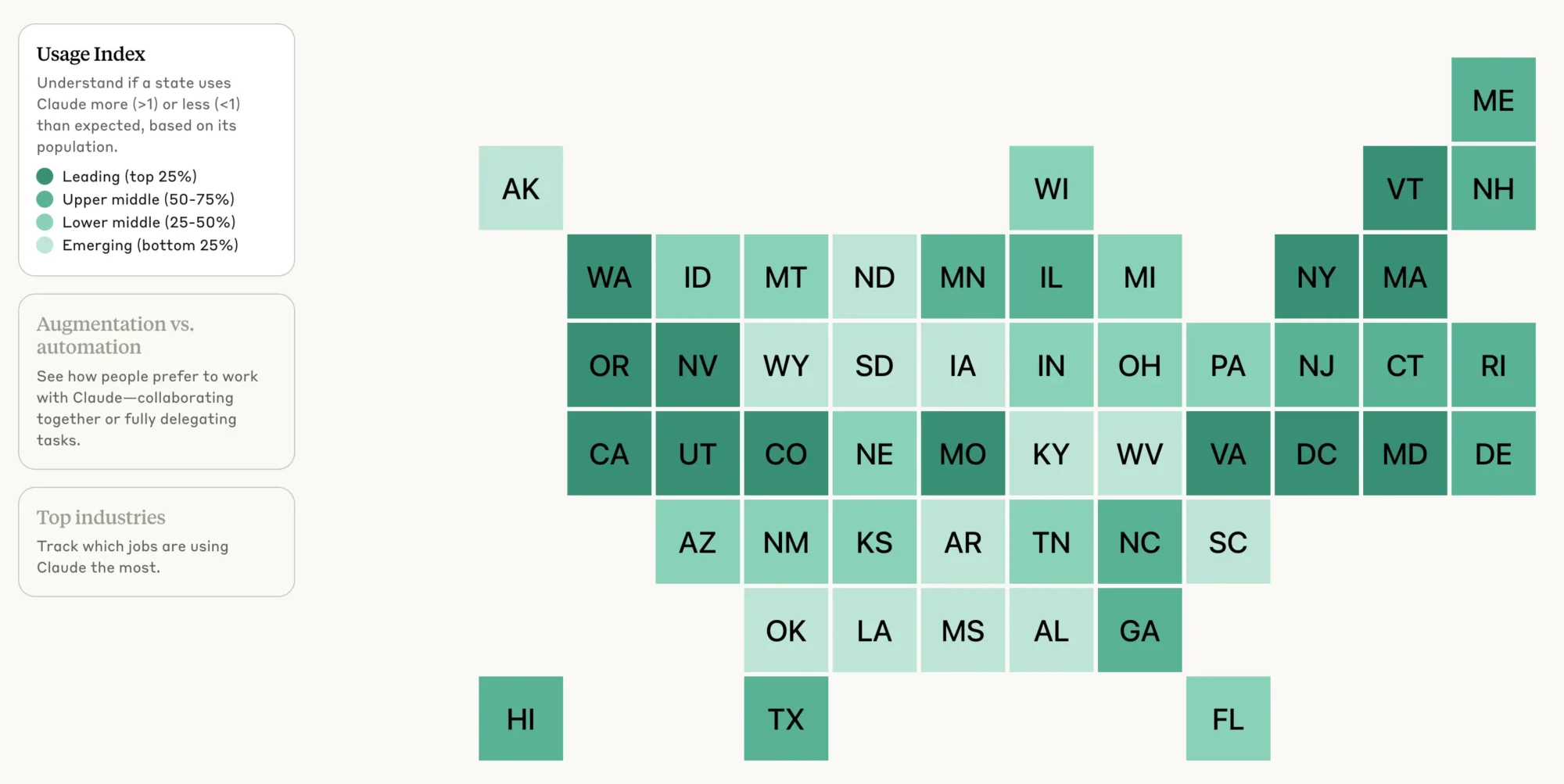
At first glance, California looks like the AI capital of America. But when adjusted for population, Washington D.C. and Utah actually lead in per-capita usage. Local economies play a big role: finance-heavy Florida leans on AI for business consulting, California for IT and translation, and D.C. for career assistance and document editing.
Enterprise AI Deployment: Automation at Scale
While individual users often use AI for learning, brainstorming, or co-creation, businesses are taking a more direct approach. Data from Anthropic’s API customers reveals:
- 77% of enterprise use cases are automation-focused—tasks handed off entirely to AI.
- Most adoption happens in coding and administrative workflows, where AI can be embedded into software and systems.
- Cost isn’t the main factor. Businesses prioritize capabilities and efficiency over price.
- Context is king. The hardest deployments aren’t limited by AI itself, but by whether organizations can provide clean, structured data for AI to work with.
This shift toward automation highlights both the promise and the risks: higher productivity, but also potential job displacement—especially for roles that are easiest to automate.
Beginner’s Corner: How You Can Start with AI
If you’ve only heard about AI in passing, don’t worry—you’re not behind. Here are three easy ways to dip your toes into the AI world:
- Start small: Use free tools like ChatGPT or Claude for simple tasks—summarizing emails, brainstorming ideas, or drafting a cover letter.
- Think of AI as a helper, not a replacement: Treat it like a smart assistant that can speed up your work, but still needs your judgment and creativity.
- Experiment daily: Ask AI to do one small task each day—whether it’s writing a LinkedIn post, generating a workout plan, or translating text. The more you practice, the more natural it becomes.
Remember: AI isn’t just for techies. It’s a tool anyone can use to save time, learn faster, and stay competitive in today’s workplace.
Implications: Inequality, Opportunity, and the Next Wave
The report warns that AI could amplify existing inequalities. Countries and companies that invest early in infrastructure, talent, and data systems are positioned to win big. Meanwhile, those without access or resources may fall further behind. However, this isn’t inevitable—policy choices, ethical standards, and strategic investments can reshape the trajectory.
For individuals, the lesson is clear: learn to collaborate with AI. The biggest gains won’t come from simply automating tasks but from integrating AI into workflows, learning faster, and leveraging it to scale creativity and problem-solving.
FAQ: Understanding the Global and Enterprise Diffusion of AI
Why is AI adoption faster than past technologies?
AI builds on existing digital infrastructure, requires little technical training, and improves rapidly. This lowers barriers compared to electricity or the internet, which needed massive infrastructure changes.
Why are some countries adopting AI faster than others?
Wealth, digital infrastructure, and industry mix matter. High-income, tech-oriented economies like Singapore and Israel have educated workforces and policies that support innovation, while emerging markets face barriers like limited internet access and lower awareness.
How are businesses using AI differently from individuals?
Individuals often use AI for learning, creativity, or productivity hacks. Businesses, on the other hand, embed AI in workflows programmatically—automating coding, document processing, and data tasks at scale.
Does AI adoption mean job loss?
Not always. While some routine roles face automation risks, workers with skills in adaptation, creativity, and contextual knowledge may become even more valuable. AI tends to disrupt some jobs but create new ones in parallel.
What should professionals do to stay relevant?
Start small: use AI tools for everyday tasks, learn to collaborate with them, and focus on areas where human judgment, creativity, or context is key. The earlier you build fluency, the more competitive you’ll be.
Final Thoughts
AI adoption is reshaping the global economy at breakneck speed—but not evenly. Whether this leads to opportunity or inequality depends on how countries, companies, and individuals respond. The bottom line? AI is not just coming. It’s here. The question is whether you’ll use it to augment your work—or risk being left behind.
AI Tools to Try Today
Want to get hands-on right away? Here’s a short list of beginner-friendly AI tools you can start experimenting with today:
- ChatGPT (OpenAI): Great for brainstorming, drafting, summarizing, and Q&A.
- Claude (Anthropic): Known for safe, reasoning-heavy responses and handling longer contexts.
- Canva AI: Perfect for quick design, presentations, and social media visuals with text-to-image features.
- Notion AI: Helpful for writing, task management, and note-taking inside your workspace.
- Perplexity AI: A conversational search engine that gives cited answers—ideal for research.
Pick one, try it for a simple task, and see how it changes your workflow. The best way to learn AI is by using it.