
In the rapidly evolving world of large language models, sampling methods and prompt design determine whether your system delivers repetitive “safe” answers or a rich spread of creative options. Verbalized Sampling (VS) introduces a simple but powerful idea: instead of requesting a single output, we ask the LLM to generate multiple candidates and attach a probability to each one. This distribution-level prompting counters mode collapse—the tendency of aligned models to repeat stereotypical responses—by surfacing more of the diversity the base model learned during pre-training. Across creative writing, dialogue simulation, open-ended QA, and synthetic data generation, VS has shown significant diversity gains while preserving safety and accuracy [1][3][8]. If you work with LLMs, this is an immediately actionable upgrade to your sampling toolkit.
What Is Verbalized Sampling (VS)?
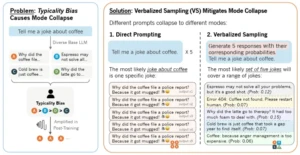
Verbalized Sampling is a training-free, model-agnostic prompting strategy from researchers at Stanford, Northeastern, and WVU. Rather than “Tell me a joke about coffee,” VS asks: “Generate 5 jokes about coffee and their corresponding probabilities.” The model responds with a set of plausible outputs plus likelihoods, letting you select from the head or tail of the distribution depending on your goal [1][3]. Because it’s purely a prompt change, VS integrates seamlessly with existing LLMs and sampling methods you already use.
Why Sampling Methods Matter in LLM Workflows
Decoding choices—temperature, top-p/top-k, repetition penalties, nucleus sampling—govern which regions of the model’s output distribution you explore. For tasks with many valid answers (ideation, story generation, social simulation, synthetic data), variety is value. Traditional knobs help, but they don’t solve the underlying bias toward typical responses introduced during alignment. VS complements these methods by explicitly asking for a distribution of responses, so you can choose outputs for novelty, breadth, or quality as needed [1].
The Core Problem: Mode Collapse & Typicality Bias
What Is Mode Collapse in LLMs?
Mode collapse occurs when a model repeatedly returns nearly the same completion despite many viable alternatives. In creative tasks, that looks like identical jokes or uniform story arcs across generations. In enumerative QA, it over-emphasizes high-frequency answers (e.g., “California,” “Texas”) and neglects the long tail [1].
Typicality Bias in Preference Data
Typicality bias is the human tendency to prefer familiar, fluent, and predictable text. Because post-training (e.g., RLHF/DPO) uses human preferences, this bias enters the reward model and sharpens the learned distribution toward stereotypical outputs. The VS paper formalizes this bias, verifies it in multiple preference datasets, and shows how it drives collapse after alignment [1][8].
How Verbalized Sampling Works
Instance-Level vs Distribution-Level Prompting
- Instance-level prompt: “Tell me a joke about coffee.” → returns one joke, often the same one repeatedly due to typicality bias.
- Distribution-level prompt (VS): “Generate 5 jokes about coffee and their corresponding probabilities.” → surfaces multiple viable jokes with likelihoods, approximating the broader pre-training distribution [1][3].
Prompt Formulation: Responses + Probabilities
Task: Generate 5 onboarding email subject lines for a SaaS product.
For each candidate, return:
 - <text>: the subject line
 - <probability>: a numeric estimate between 0 and 1
Constraint: Prefer novelty; each probability < 0.10.
Use the returned list to pick a candidate (e.g., select a lower-probability option for novelty) or to sample proportionally to the verbalized probabilities. This makes diversity tunable at inference time and complements your existing sampling methods [1].
Empirical Evidence & Results
Creative Writing (Poems, Jokes, Stories)
Across creative tasks, VS increases diversity by ~1.6–2.1× relative to direct prompting while maintaining quality. Human evaluations report sizable diversity gains and moderate-to-high inter-annotator agreement (e.g., 0.87 for stories, 0.86 for jokes), indicating reliable improvements [1][3].
Dialogue Simulation & Open-Ended QA
On the PersuasionForGood benchmark (donation-dialogues), VS generates more human-like distributions of outcomes—closer to real donation behaviors—sometimes rivaling specialized fine-tunes [1][2][5][9]. For enumerative QA (e.g., listing US states), VS achieves far lower KL divergence to pre-training statistics than direct prompting, avoiding collapse onto a handful of frequent answers [1][3].
Synthetic Data Generation & Downstream Gains
VS-generated synthetic datasets (e.g., math) improve downstream performance when used for fine-tuning, compared to datasets produced by direct prompting. The approach also helps produce negative synthetic data (plausible incorrect solutions) for robustness training—without harming safety or factuality on standard checks [1].
Key Advantages of Verbalized Sampling
- No retraining required: Purely a prompting change—drop-in for production workflows [1].
- Model-agnostic: Demonstrated across GPT-4-series, Claude, Gemini, Llama, Qwen, and others [1][4][10][11].
- Tunable diversity: Adjust probability thresholds to move up or down the novelty spectrum.
- Orthogonal to decoding: Combine with temperature, top-p, and min-p to refine your sampling methods [1].
- Preserves safety and accuracy: Comparable refusal rates and commonsense accuracy to baselines in reported tests [1][3].
- Scaling effect: Larger/more capable models often see greater diversity and quality gains under VS [1].
Practical Implementation Tips
Crafting an Effective VS Prompt
- Specify N candidates (e.g., 5–10).
- Require a numeric probability for each candidate.
- Optionally enforce a max-probability threshold (e.g., < 0.10) to emphasize tail sampling.
- Post-process by sampling from probabilities or by selecting lower-probability candidates for novelty.
- Log and evaluate diversity (semantic similarity spread, coverage-N, KL divergence) plus human ratings for quality.
Combining VS with Temperature / Top-p / Min-p
VS adds a second axis of control. A practical recipe: run temperature ~0.8–0.9 with top-p 0.9; ask for 10 candidates with probabilities; then select a candidate under a probability threshold or sample proportionally to the provided distribution. Iterate to fit your domain’s diversity-quality trade-off [1].
Safety, Accuracy & Calibration
VS does not inherently reduce safety or factuality in reported studies, but tail sampling can introduce oddities. Treat verbalized probabilities as relative (not perfectly calibrated). Add guardrails and validation for user-facing use cases, especially when deploying at scale [1][3].
Use Cases & Real-World Applications
Creative Ideation & Content
Brainstorm slogans, plot twists, or social posts by surfacing multiple high-quality options at once. This directly supports teams seeking to increase LLM output diversity in ideation pipelines.
Dialogue Systems & Social Simulation
For behaviorally realistic simulations, VS yields distributions of outcomes closer to human data on benchmarks like PersuasionForGood, improving fidelity over direct prompting alone [1][2][5].
Synthetic Dataset Creation
Use VS to generate positive and negative synthetic examples for training/robustness. The broader coverage helps downstream generalization and reduces overfitting to stereotyped patterns [1].
Limitations & Open Questions
When VS Might Not Be Necessary
If your task demands a single precise answer (e.g., verified fact retrieval), the overhead of generating multiple candidates might not pay off. Consider VS primarily where multiple acceptable answers exist.
Probability Calibration & Tail Risks
LLM-verbalized probabilities aren’t guaranteed to be well-calibrated. Use them as ranking signals rather than absolute truth. Tail sampling can increase novelty and risk; add QA/filters appropriate to your domain.
The Future of Sampling Methods in LLMs
Distribution-Aware Prompting
VS points toward a broader shift: from tuning token-level decoders to eliciting distributions of solutions and explicit uncertainties. Expect hybrids with rejection sampling, self-consistency, and confidence calibration.
Reducing Collapse at the Source
Alongside inference-time fixes, improving preference data to counter typicality bias remains a key research direction—especially for open-ended, creative, and multi-answer domains [1].
Custom Visual Concepts (for your designer)
- Infographic: “From Single Answer to Distribution”
Description: Left panel shows a single, bold output (“safe answer”) from an LLM box; right panel shows five varied outputs with attached p-values (e.g., 0.18, 0.16, 0.12, 0.07, 0.05). An arrow labeled “Verbalized Sampling” connects panels.
Alt text (SEO): “Verbalized Sampling for LLMs converts single answers into a distribution of responses with probabilities using smarter sampling methods.” - Chart: “Diversity Gain vs. Prompting Strategy”
Description: Bar chart comparing Direct, Temperature+Top-p, and VS on a “semantic diversity” score, with VS ~1.6–2.1× higher than Direct (annotate range). Include a note “results summarized from reported evaluations.”
Alt text (SEO): “Bar chart showing Verbalized Sampling improves LLM output diversity over traditional sampling methods.” - Flow Diagram: “VS in a Production Stack”
Description: Boxes: Prompt → LLM (VS prompt) → N candidates + probabilities → Selector (threshold or sampling) → Safety/QA → Final Output. Side notes: “orthogonal to temperature/top-p,” “no retraining.”
Alt text (SEO): “Workflow diagram of Verbalized Sampling integrated with LLM sampling methods and safety checks.”
Quick Takeaways
- VS = multiple responses + probabilities to unlock latent diversity in LLMs [1].
- Directly addresses mode collapse rooted in typicality bias in preference data [1][8].
- Delivers ~1.6–2.1× diversity gains in creative tasks without hurting safety/accuracy [1][3].
- Training-free, model-agnostic, and compatible with all major sampling methods.
- Tune novelty via probability thresholds; combine with temperature/top-p for fine control.
- Ideal for creative ideation, social/dialogue simulation, and synthetic data generation.
Conclusion
Sampling methods are the steering wheel of LLM behavior. But alignment-induced typicality bias can push models toward a narrow band of predictable outputs. Verbalized Sampling offers a low-friction fix: ask for a distribution of candidates with probabilities, then select or sample to match your goals. Evidence shows VS boosts diversity (often 1.6–2.1×) across creative, dialogue, and enumerative tasks, while maintaining safety and accuracy. No retraining, no model swapping—just a smarter prompt that’s orthogonal to your existing decoding setup. If your product or research depends on variety, novelty, or broad coverage, add VS to your stack, experiment with probability thresholds, and measure both diversity and quality. It’s a pragmatic step toward distribution-aware prompting and more robust, human-aligned LLM systems [1].
FAQs
1) How is Verbalized Sampling different from top-p or temperature?
Top-p and temperature work at the token level during decoding. VS changes the prompt to elicit multiple full responses with probabilities, giving you an explicit distribution to sample from—complementary to standard methods [1].
2) Will VS reduce accuracy or safety?
Reported evaluations show comparable factual accuracy and refusal behavior to direct prompting. Tail sampling can add noise, so keep domain-appropriate validation in place [1][3].
3) What tasks benefit most from VS?
Creative writing, brainstorming, social/dialogue simulation, enumerative QA, and synthetic data generation—anywhere multiple valid outputs exist and diversity adds value [1][2].
4) How many candidates and what thresholds should I use?
Start with N=5 (or 10 for breadth). For novelty, try a maximum probability per candidate (e.g., < 0.10). Tune based on coherence and your KPIs, alongside temperature/top-p settings [1].
5) Does VS work across different LLM families?
Yes. VS is model-agnostic and has been demonstrated across GPT-4-series, Claude, Gemini, Llama, and Qwen; open-source code/examples are available [1][4][10][11].
References
- Zhang et al. (2025). Verbalized Sampling: How to Mitigate Mode Collapse and Unlock LLM Diversity.
- Wang et al. (2019). Persuasion for Good: Towards a Personalized Persuasive Dialogue System for Social Good.
- Verbalized Sampling (HTML version with detailed results and figures).
- CHATS-lab Verbalized Sampling — GitHub repository (Apache-2.0).
- Saha et al. (2021). Performance of BERT on Persuasion for Good.
- OpenReview PDF mirror of Verbalized Sampling (for archival access).
- Project site: Verbalized-Sampling.com (overview and highlights).
- AlphaXiv overview of Verbalized Sampling (summary).
- Related: Measuring/Benchmarking Persuasive Language in LLMs (context on persuasion distributions).
- CHATS-lab organization (activity and commits).
- Alternate repo slug: verbalize-sampling (redirects/duplicate naming).